
There is a version of senior fall that goes smoothly. Applications get submitted with time to spare, essays go through real revision instead of last-minute panic, and recommendation letters arrive without a frantic email chain in the final week. Then there is the version most students actually experience, where everything piles up at once and the whole season feels like a sprint.
The difference almost always comes down to one thing: having a timeline and actually following it. Application deadlines do not sneak up on anyone in theory. But without a plan that breaks the work into manageable pieces, even organized students end up scrambling. This guide walks through how to build a timeline that keeps you ahead of the deadlines instead of chasing them.
Start by Mapping Out Your Actual Deadlines
Before you can build a timeline, you need to know exactly what you are working toward. A surprising number of students start working on applications without a clear, written list of every deadline they are facing, and that gap is where a lot of the stress originates.
Make a complete list of every school you are applying to and the deadline type you are using for each. This matters because deadlines vary depending on the path you choose. Early Decision and Early Action deadlines typically fall in early to mid November. Regular Decision deadlines are usually in early to mid January, though some schools set them in December. Rolling admissions schools accept applications over an extended window but reward early applicants with earlier decisions and often better access to financial aid and housing.
For each school, write down the exact deadline, the application platform it uses, whether it requires supplemental essays, what testing requirements apply, and any school-specific materials. Also note any priority deadlines for scholarships or honors programs, since those sometimes fall earlier than the general admission deadline. Missing a scholarship priority deadline because you were focused only on the admission deadline is a costly and avoidable mistake.
Work Backward From Your Earliest Deadline
Once you know your deadlines, build your timeline backward from the earliest one rather than forward from where you are now. This reframes the process around when things actually need to be done rather than when you feel like getting to them.
If your earliest deadline is an Early Action application due November 1, that date is your anchor. You want your application essentially complete a week or two before that date, which means the work that feeds into it needs to start considerably earlier. Working backward also reveals scheduling conflicts you might not otherwise catch. If two schools have deadlines a few days apart and both require supplemental essays, you can see that crunch coming weeks in advance rather than discovering it the week it hits.
A Realistic Month-by-Month Timeline
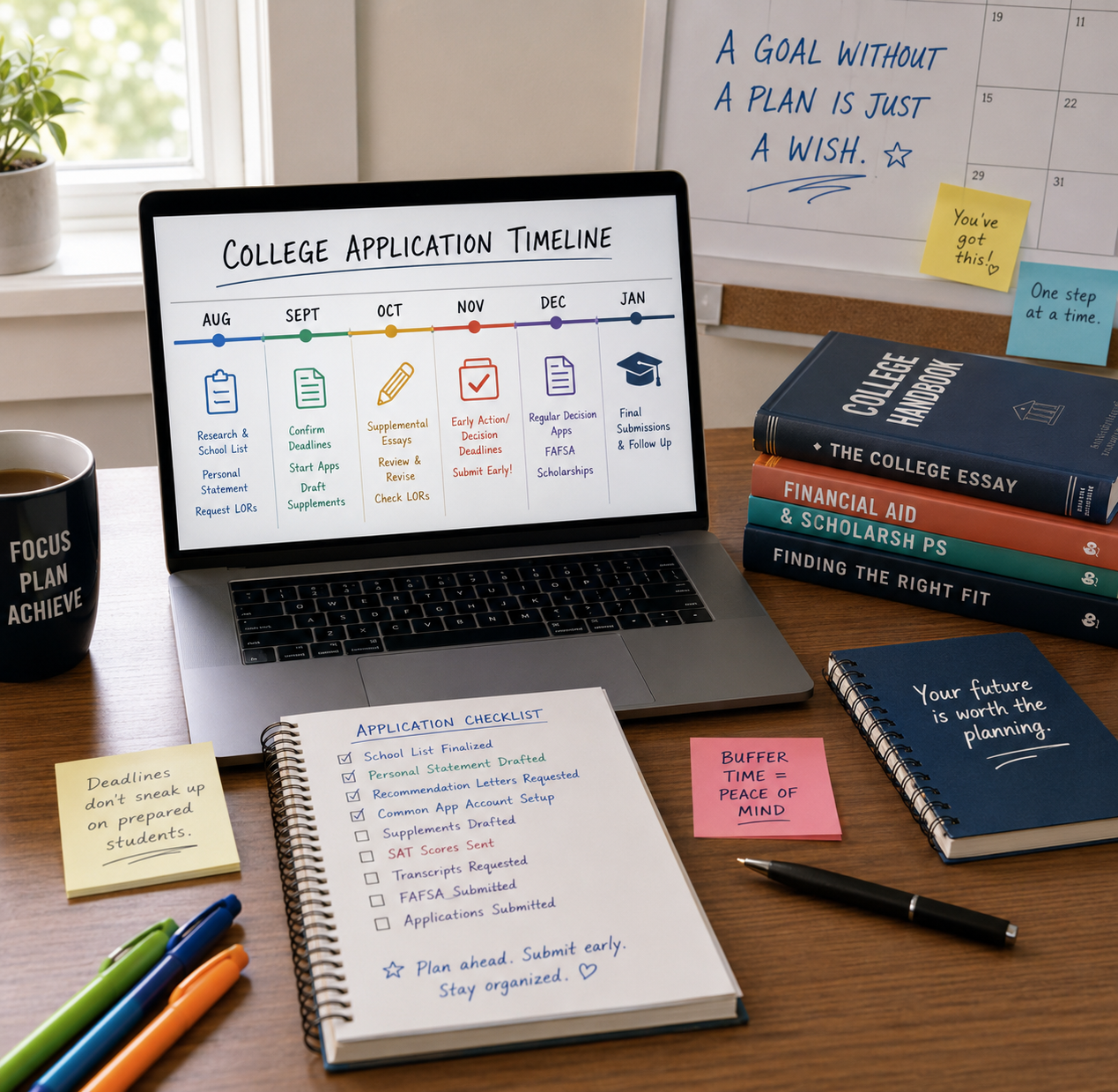
Every student’s situation is different, but this framework gives you a sense of how the work distributes across the season.
Summer before senior year is when the foundational work should happen. Finalize your school list, draft your main personal statement, request recommendation letters, and gather the materials you will need. A personal statement that goes through real revision over the summer is dramatically stronger than one written in October between everything else.
Early September is for confirming the deadline and requirements for each school, setting up your application platform accounts, and beginning the application forms, which take longer than most students expect. Start drafting supplemental essays for your early-deadline schools.
Late September into early October is supplemental essay season. Schools with early deadlines often require multiple supplements, and the “why this school” essays require research into each program. This is also the window to confirm your recommenders are on track.
Mid to late October is for finalizing and reviewing early-deadline applications with enough time for a careful review, not a rushed one. Confirm test scores have been sent, transcripts requested, and every component accounted for.
Early November is when early applications are due. With a proper timeline, this feels like crossing a finish line you prepared for rather than a desperate push.
November into December is for completing regular decision applications. The work you did on your personal statement and early supplements often transfers, but each school’s specific supplements still need attention. Stay on top of financial aid forms, including the FAFSA, during this period.
December into early January is for finalizing and submitting regular decision applications ahead of their deadlines, ideally several days early rather than racing the clock on deadline day, when platforms experience heavy traffic.
Build in Buffer Time Everywhere
The single most useful principle is to treat every personal deadline as earlier than the actual one. The students who run into trouble are almost always the ones who planned to finish exactly on the deadline and then hit an unexpected obstacle.
Things go wrong. A recommender submits late. An essay takes three drafts instead of one. The application platform has a technical issue on the day a deadline falls, which happens more often than you would think because thousands of students are submitting at once. None of these are catastrophic if you have built in buffer time. A good rule of thumb is to set your personal target for completing each application a full week before the deadline.
Managing Recommendation Letters Without the Stress
Recommendation letters deserve special attention because they are the one major component you do not control directly. You are dependent on someone else’s schedule, which means they require more lead time than the parts of the application you handle yourself.
Ask your recommenders as early as possible, ideally before the end of junior year or at the very start of senior year. The teachers who are asked first have more time to write thoughtful letters rather than rushed ones. When you ask, give them a clear list of schools and deadlines, any specific qualities you hope they might highlight, and a sense of your goals. Then follow up politely a couple of weeks before each deadline. Most teachers are managing many of these at once, and a helpful reminder is a kindness rather than an imposition.
Keep Everything in One Place
A timeline only works if you can see it and track your progress against it. A simple spreadsheet works well for most students. List each school as a row and create columns for the deadline, application platform, supplemental essays required, recommendation letters needed, test scores sent, transcript requested, and submission status. Updating it as you complete each component gives you a clear, at-a-glance picture of where everything stands.
The value is not just organization for its own sake. It is the reduction in mental load that comes from knowing nothing is falling through the cracks. When everything is tracked in one place, you do not have to hold the entire process in your head, which frees up energy for the actual work of writing strong applications.
If the process feels overwhelming or you are not sure how to build a timeline that fits your situation, that is exactly the kind of thing a college planning advisor can help with. At Lighthouse College Planning, we help students and families map out a clear, personalized plan that replaces last-minute stress with a sense of control. Reaching out early, before the fall crunch begins, is the best way to set yourself up for a smoother season.
Frequently Asked Questions About College Application Timelines
When should I start working on my college applications?
The summer before senior year is the ideal time to begin the foundational work, including finalizing your school list, drafting your personal statement, and requesting recommendation letters. If you have not started by the time school begins in the fall, the next best time is right now.
What is the difference between Early Decision, Early Action, and Regular Decision?
Early Decision is a binding commitment, meaning if you are accepted you agree to attend, with deadlines typically in early November. Early Action is non-binding but still has an early deadline. Regular Decision has later deadlines, usually December or January, and gives you more time. Each path has tradeoffs worth discussing with a counselor before deciding.
How far in advance should I ask for recommendation letters?
As early as possible, ideally before the end of junior year or the very start of senior year. Asking early means your recommender has time to write a thoughtful letter rather than a rushed one, and you are not competing with every other student who asked first.
What happens if I miss a deadline?
It depends on the school and the deadline type. Some schools have no flexibility, while rolling admissions schools have more. The best approach is to build enough buffer into your timeline that missing a deadline is not a realistic possibility. If you do miss one, contact the admissions office directly and honestly to ask about your options.
How much buffer time should I build into my timeline?
Set your personal target for completing each application a full week before the deadline. That buffer absorbs the small delays that inevitably come up, turning potential crises into minor inconveniences.
Should I submit my application right at the deadline or earlier?
Earlier, without question. Application platforms experience heavy traffic as deadlines approach, and technical issues are most likely when thousands of students submit at once. Submitting several days early avoids that risk and gives you peace of mind.